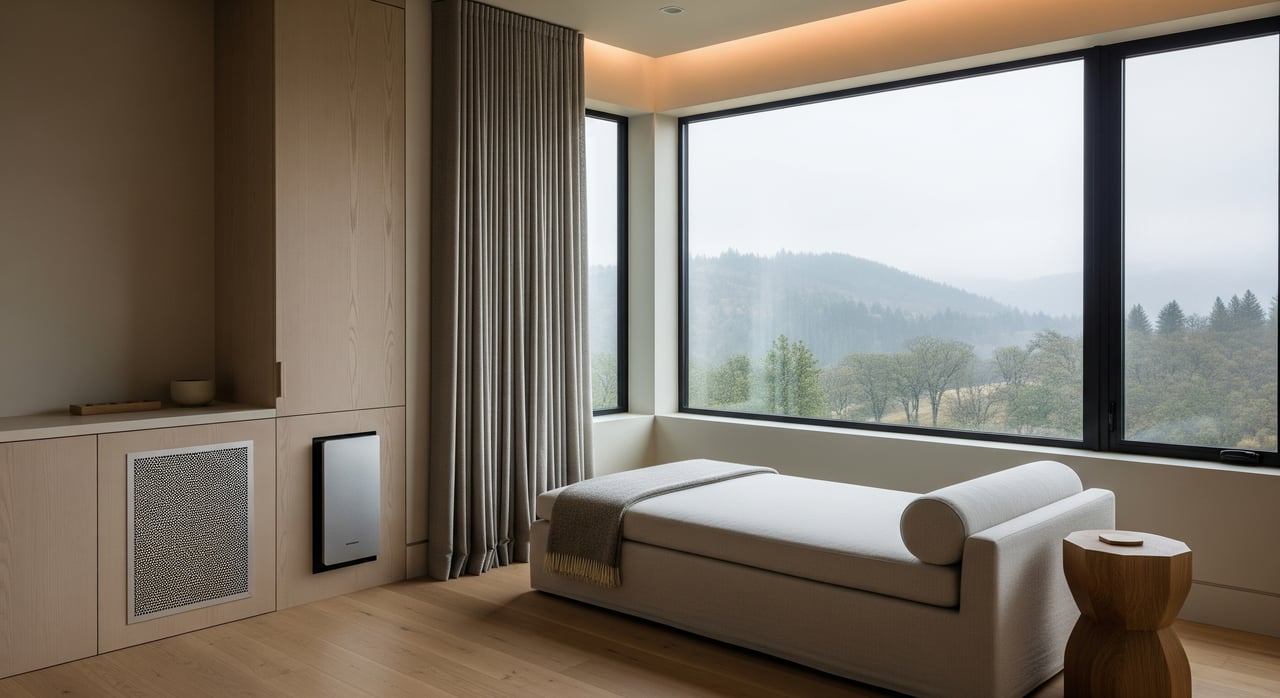
When wildfire smoke settles over the Rogue Valley, it often finds its way inside. You might notice a smoky smell, irritated eyes, or a dry cough even with the windows closed. If you live in Jackson County, planning a cleaner‑air room can make a real difference for your comfort and health during smoke events. In this guide, you’ll learn how to choose the right room, seal it, pick and size an air cleaner, set your HVAC for smoke days, and monitor air quality with confidence. Let’s dive in.
Why a cleaner‑air room matters in Jackson County
Wildfire smoke carries fine particulate matter called PM2.5. These tiny particles can irritate your lungs and make existing conditions worse. They affect everyone, and the risks are higher for children, older adults, pregnant people, and anyone with asthma or heart and lung disease.
Jackson County often sees seasonal smoke and sudden episodes when nearby fires flare. During those times, you need a simple plan to reduce your indoor exposure quickly. A cleaner‑air room helps you breathe easier until conditions improve.
To track regional conditions, check the federal AirNow Fire and Smoke Map and Oregon’s DEQ smoke and air quality updates. For statewide guidance and updates tailored to Oregonians, bookmark Oregon Smoke.
Pick the right room
Choose a small to medium interior room with few windows and exterior walls. An interior bedroom or office works well. Use a space where you can rest or work for several hours if needed.
Avoid rooms with gas appliances or fireplaces. If a bathroom is attached, keep the exhaust fan off during smoke periods. The goal is to limit outdoor air getting in and to make filtration easier.
Seal it tight
Reducing leaks makes your filter work better. Try this quick checklist:
- Close and latch all windows and exterior doors.
- Add temporary weatherstripping or painter’s tape around leaky window and door edges.
- Use a door sweep or a rolled towel along the bottom of the door.
- If needed for short‑term use, cover windows with clear plastic sheeting and tape. Do not block emergency exits.
- Close any vents that bring in outdoor air and keep interior doors closed to reduce drafts.
Filter the air
Filtration is the heart of a cleaner‑air room. You have three practical options.
Portable HEPA air cleaner
A true HEPA unit captures about 99.97% of very small particles. It is often the most effective room‑by‑room approach for smoke. Look for:
- A stated Clean Air Delivery Rate (CADR) for smoke that matches your room size.
- True HEPA filtration and low ozone emissions.
- Simple placement near where you sit or sleep, away from obstructions.
Whole‑home HVAC with MERV‑13
If your furnace or air handler supports it, a high‑quality MERV‑13 filter can reduce fine particles across the home. Set the fan to ON during smoke events so air moves through the filter continuously. If you are unsure whether your system can handle a higher‑MERV filter, check the manufacturer’s specs or consult a licensed HVAC technician.
DIY filter fan (Corsi‑Rosenthal box)
A well‑built box fan with MERV‑13 filters is a budget‑friendly option. Use a modern UL‑listed fan, secure the assembly, and place it where it will not be tipped over. Do not leave it running unattended for long periods, and replace filters when they load up with smoke.
Set HVAC for smoke days
A few simple settings help keep smoke out:
- Turn off outdoor‑air intakes or mechanical ventilation that pulls outside air inside.
- Set the thermostat fan to ON rather than AUTO so the system filters continuously.
- Use air conditioning as needed for comfort, but avoid opening windows while smoke is high.
Size your air cleaner the simple way
Right‑sizing your air cleaner matters. You can estimate the needed CADR in a few steps.
- Measure the room: length × width × ceiling height = volume (cubic feet).
- Pick a target air changes per hour (ACH). A practical range is 4 to 6 ACH for a cleaner‑air room.
- Use the formula: Required CADR (cfm) = (Room volume × ACH) ÷ 60.
Example: A 12 ft × 12 ft × 8 ft bedroom is 1,152 cubic feet. For 4 ACH, you need about 77 cfm. For 6 ACH, about 115 cfm.
Here is a quick reference for typical rooms:
| Room size (8 ft ceilings) | Volume (cu ft) | CADR for 4 ACH | CADR for 6 ACH |
|---|---|---|---|
| 10 × 12 ft | 960 | 64 cfm | 96 cfm |
| 12 × 12 ft | 1,152 | 77 cfm | 115 cfm |
| 14 × 14 ft | 1,568 | 105 cfm | 157 cfm |
Tip: If one unit does not meet your target, add a second unit or choose a model with a higher smoke CADR. Manufacturers list smoke CADR on product specs.
Run, monitor, and maintain
Once your room is set up, keep it working with these habits:
- Run portable HEPA units continuously while you are in the room during smoke events.
- Keep the HVAC fan on to move air through the filter across the home.
- Replace disposable HVAC filters after heavy smoke exposure or when visibly loaded.
- Follow the manufacturer’s schedule for changing HEPA filters and prefilters, and replace DIY box‑fan filters when airflow drops.
- Track indoor air with a simple PM2.5 sensor if you have one, and compare trends to outdoor conditions.
For indoor and outdoor trends, community sensor networks like PurpleAir’s map can be helpful. Use them to follow local changes, and pair that with official sources like AirNow for health‑based AQI categories.
Stay informed during smoke events
Use a few trusted sources to decide when to set up or stand down your cleaner‑air room:
- Check the AirNow Fire and Smoke Map for current AQI and smoke plumes.
- Review Oregon DEQ smoke advisories and monitoring for statewide updates.
- Follow Oregon Smoke’s statewide guidance during active incidents.
- Learn about health impacts and protective steps from the EPA’s wildfire smoke and indoor air guidance and the CDC’s wildfire smoke pages.
Safety tips you should know
Simple choices keep your room effective and safe:
- Avoid any air cleaner that generates ozone or relies on ionization or ozone to “clean” air.
- Do not use kitchen range hoods or bathroom fans while smoke is high, since they can pull in smoky outdoor air.
- Skip candles, incense, and indoor smoking in your cleaner‑air room.
- Spread electrical loads across outlets and avoid daisy‑chaining extension cords when running multiple devices.
When to get more help
If anyone in your home has severe symptoms such as difficulty breathing, chest pain, fainting, or severe coughing, seek medical attention. If smoke levels remain hazardous and you cannot lower indoor PM2.5, check county and state updates for community clean air centers or shelter options during prolonged events.
How this fits your home plans
If you are buying, look at window condition, HVAC age, filter access, and room layouts that make a cleaner‑air room easy to set up. If you are selling, a few practical upgrades such as better weatherstripping and a MERV‑13‑ready filter slot can signal care and readiness for local conditions. In Jackson County’s wildfire seasons, small steps like these improve comfort and peace of mind.
Ready to talk through home features that help during smoke season, or to plan your next move in the Rogue Valley? Let’s connect with the local team that knows Jackson County well. Misener Property Group is here to help.
FAQs
What is a cleaner‑air room for wildfire smoke?
- It is a sealed room in your home where you reduce smoke infiltration and use strong filtration to lower indoor PM2.5 during wildfire events.
Which air purifier is best for smoke in a bedroom?
- A portable unit with true HEPA and a smoke CADR that meets your room’s needs is a strong choice. Match CADR to your room size using the 4 to 6 ACH target.
Will a MERV‑13 HVAC filter work as well as HEPA?
- MERV‑13 captures many fine particles and is great for whole‑home filtering if your system can handle it. A true HEPA room purifier is usually more efficient on a single room.
Should I run my HVAC fan on ON or AUTO during smoke?
- Use ON so air moves through the filter continuously. Make sure outdoor‑air intakes or ventilators are off so you are not bringing smoky air indoors.
Can I use my stove hood or bathroom fan to clear smoke indoors?
- No. Those fans exhaust indoor air and can draw smoky outdoor air into the home while outdoor air quality is poor.
How do I know when to start or stop using a cleaner‑air room?
- Watch AQI trends on trusted sources like the AirNow Fire and Smoke Map and Oregon DEQ. When AQI improves to safer levels, you can gradually return to normal ventilation.